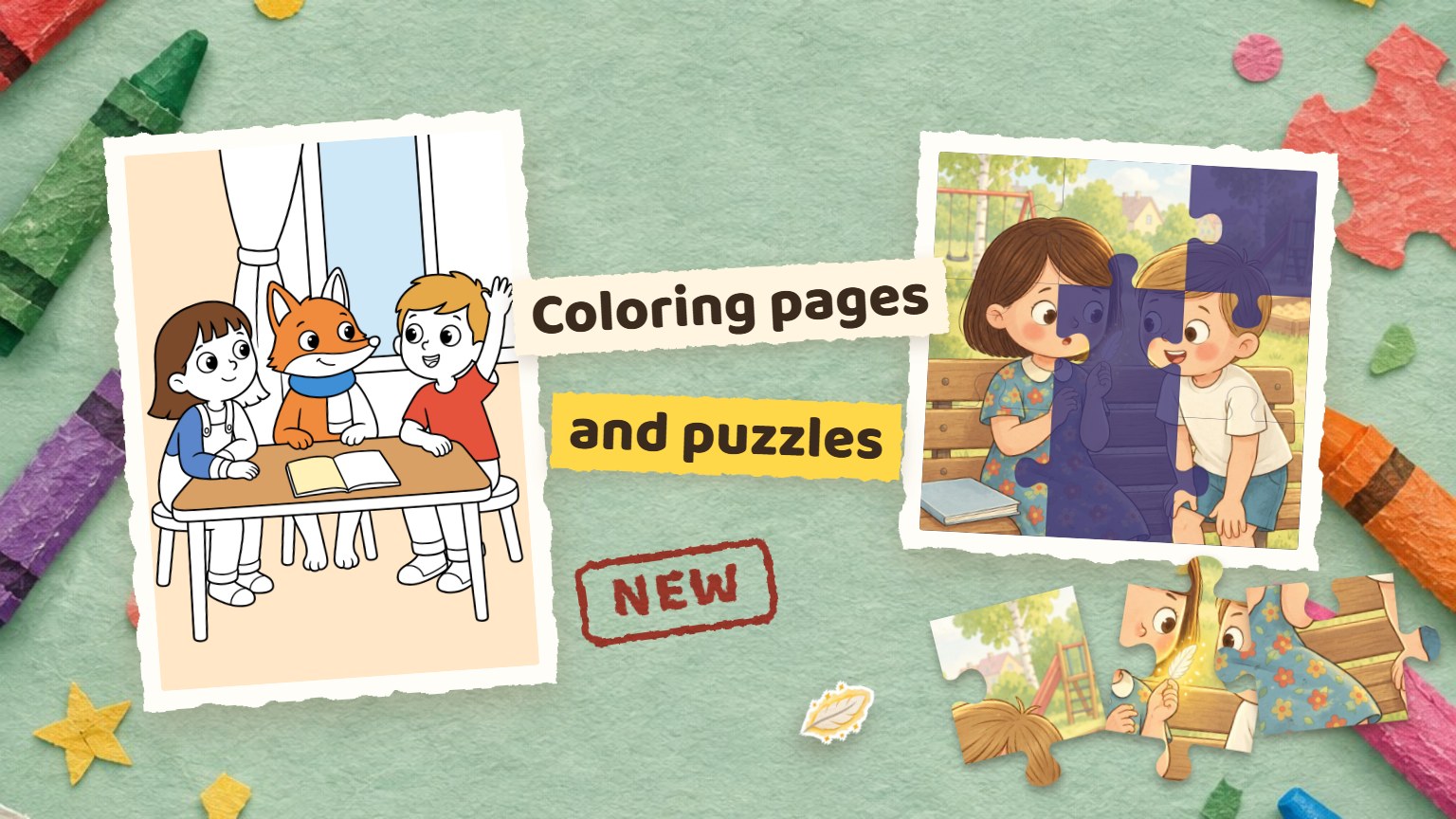
Coloring a character or putting together a familiar scene can be a simple activity after a daytime story. A story illustration gives children a starting point: they can choose different colors, rebuild the picture as a puzzle, or talk about the moment it brings to mind.
Choosing an activity for your child
The activity doesn’t need to become another assignment. A few choices can help it fit your child’s interest and the time you have:
- Paper or screen: A printed coloring page and crayons can work well at the kitchen table. A digital coloring page or puzzle may be more convenient on a train or in a waiting room.
- A quick activity or a longer project: During a short wait, a small puzzle may be a better fit than a complicated one. On a slow afternoon, there’s more room for detailed coloring or a bigger challenge.
- Conversation or quiet play: If your child wants to talk, a question such as “What do you remember about this picture?” can connect the activity to the story. Coloring quietly is an option, too.
How Storylandia’s story activities work
Storylandia has audio stories for children ages 4–10, with coloring pages and puzzles based on story illustrations.
The sequence starts with listening. For subscribers, a quiz comes next—one quiz per story—followed by the coloring pages and puzzles. The quiz is a subscription feature, separate from the free extras described below.
Each story’s available extras are under the Extras button on that story’s screen. They require the latest mobile app version from Google Play or the App Store.
Coloring pages: on screen or printed
Storylandia’s coloring pages come in two levels: Simple, with large areas, and Detailed, with smaller sections. Large areas may suit a child who wants a quicker activity; detailed pages offer more to work on.
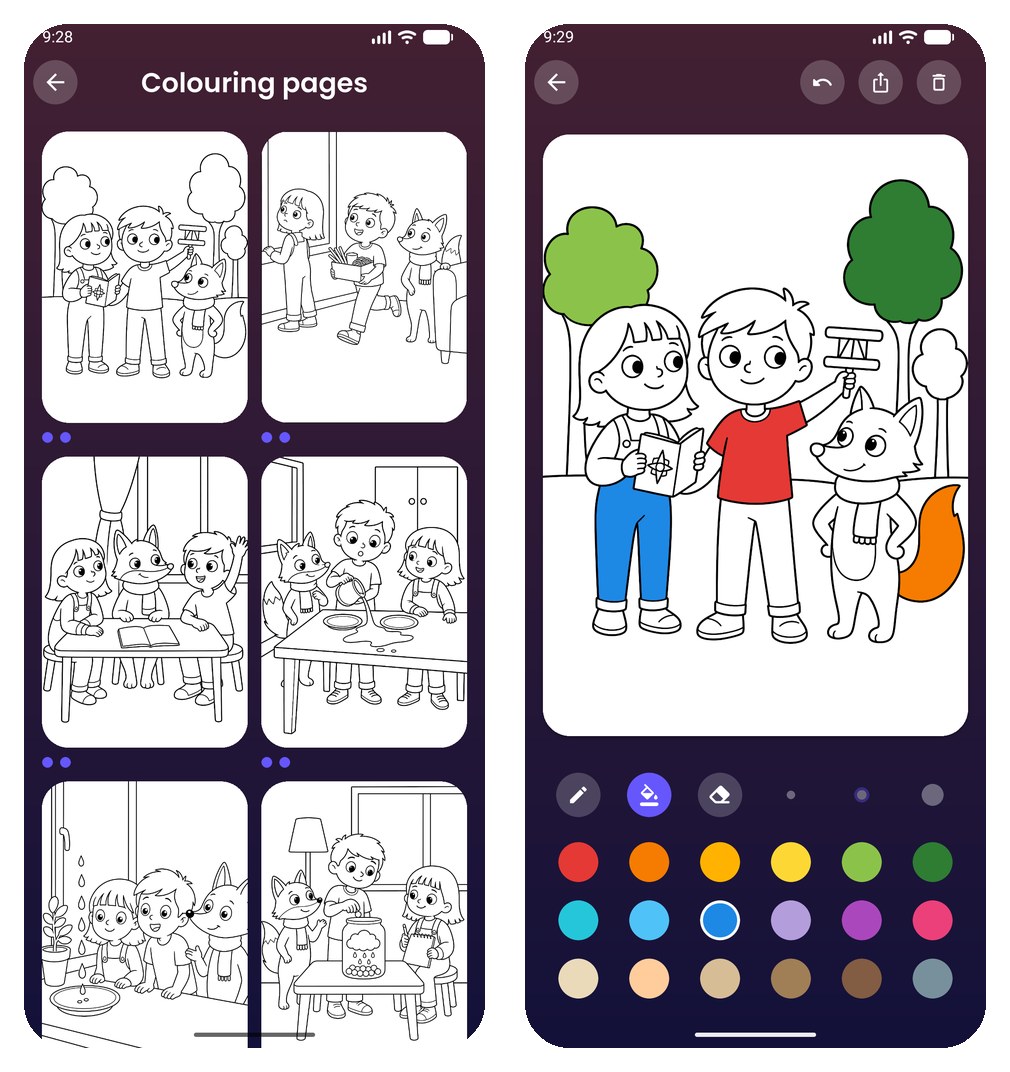
In the app, children can use a pencil or paint bucket, make changes with an eraser, and zoom in on small details.
A coloring page can also be saved and printed. That makes it possible to listen during the day and return to the illustration later with paper and crayons, without continuing on a screen.
Picture puzzles: four ways to rebuild a scene
The puzzles offer four modes:
- Sliding: sliding tiles into the empty spot.
- Swapping: swapping any two tiles.
- Rotating: turning tiles until the picture is upright.
- Jigsaw: dragging the pieces into place.
Grids range from 2×2 to 8×8, so a familiar illustration can become either a short activity or a more involved puzzle.
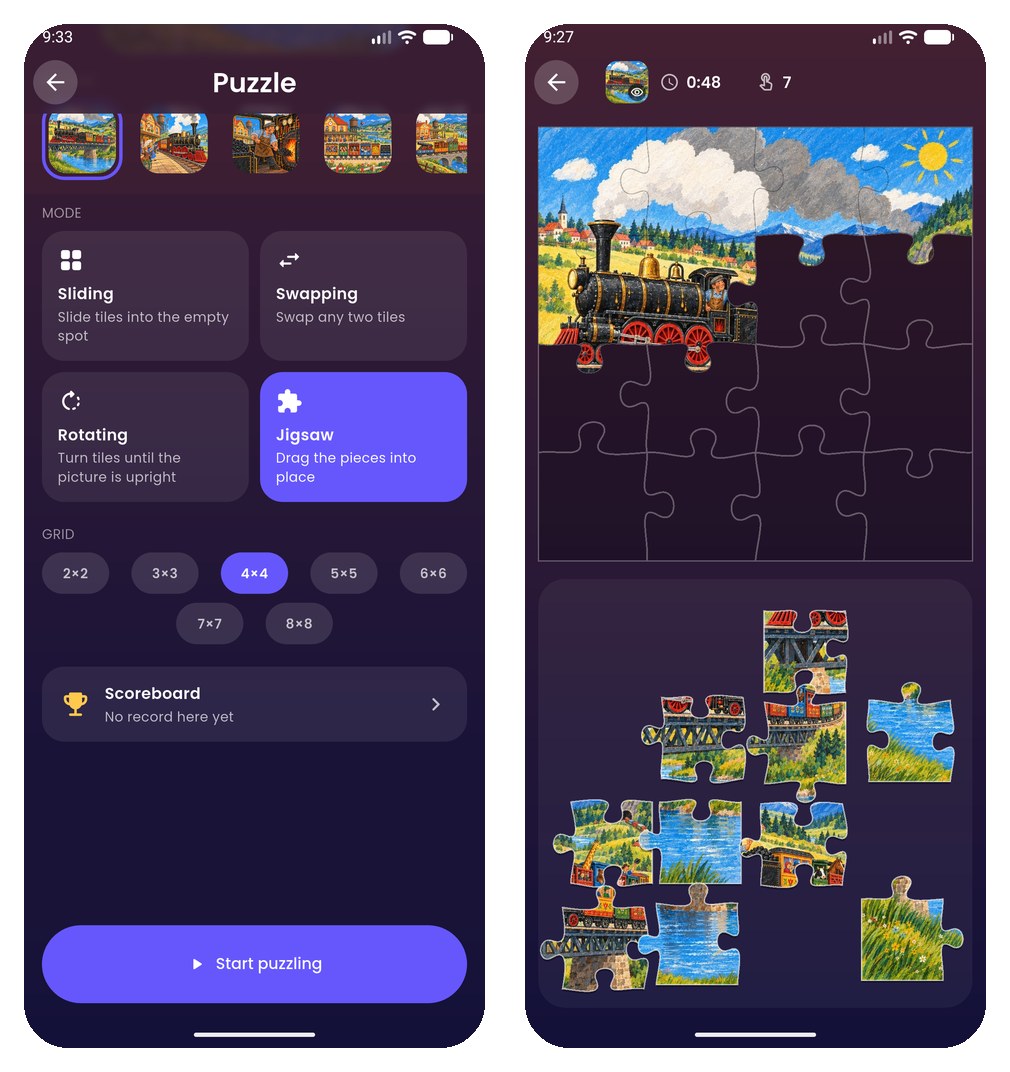
A smaller grid is a reasonable starting point if your child is new to picture puzzles. If they get stuck, looking together for a recognizable character or object can give them somewhere to begin. There’s no need to move to a larger grid just because they finish a smaller one.
Which coloring pages and puzzles are free?
All coloring pages and puzzles for the first episode of every Storylandia series are free permanently, with no subscription and no Magic Quills. This rule also applies to future series.
The full set of coloring pages and puzzles for The Locomotive, Julian Tuwim’s classic poem, is also free permanently.
For the other ready-made library extras:
- With a subscription: All coloring pages and puzzles are unlocked.
- Without a subscription: Extras for a chosen story can be unlocked with Magic Quills, Storylandia’s in-app currency.
Coloring pages from your own stories
A coloring page can also be generated from a personalized story made in Storylandia, giving a child an illustration from a story they helped create.
This is separate from the ready-made library extras: generating a coloring page from your own story always costs Magic Quills, even with a subscription.